Longboard types
Longboard types : main characteristics
Board length and wheelbase
Length is the first thing you notice when you look at the longboards on display in a shop. The longer the board, the more stable it will be. Most cruising boards are between 38” and 42”.On the other hand, longer boards will be harder to turn, whereas shorter boards can take sharper turns.
Wheelbase is the distance between the wheels, more specifically between the inner truck mounting holes. This distance, combined with deck shape, is important because it determines how your feet will be positioned relative to the trucks (e.g. on top of the trucks or not), which affects responsiveness.
A longer wheelbase also makes for a more stable board, which is why it’s often quite long on speed boards (there are many other factors at play for speed riding though, keep reading).
Deck construction and flex
Decks are made by pressing together multiple layers of wood, bamboo, and/or composite materials. Deck construction plays an important role in the type of longboard being assembled and the riding styles it is best adapted for.
The most common and least expensive decks are made from maple or Baltic birch wood thin laminates pressed into shape. These are durable, the more layers the stiffer, and are the most common in basic cruiser boards.
Next up are decks made of bamboo sheets wrapped in composite laminates. More lightweight and with much more flex and springiness. Also quite durable. Flex is good for freestyle tricks, for example, but not so good for speed.
The most expensive and high performance type of decks are made from composite such as fiberglass, interwoven with some wood. These are lightweight and have flex properties that make the boards more forgiving and resistant to pressure. Great for speed boards.
Deck flex can be classified as soft / medium / stiff, depending on construction and shape :
- Soft (cruising) : great shock absorption but very unstable at higher speeds
- Medium (carving) : stable at speed, responsive to carving moves, moderate speed
- Stiff (freeride) : stability at higher speeds, less forgiving on bumpy ground
Mount type
Different mount types (aka styles) can be used on different types of longboards. Mount type refers to the way the trucks that hold the wheels are mounted onto the deck.
Why is it important ? Depending on how the trucks are mounted, the center of gravity of the longboard rider will be higher or lower, which affects stability (the lower the more stable).
A lower deck brings more stability and reduces the rider’s effort to drop his/her foot to the ground for pushing and foot braking (cruising). A lower gravity center also makes sliding easier.
Mount type also affects whether the rider’s feet sit on top of the trucks or further from them, which impact the longboard’s turning agility. If your feet are on top of the trucks, you get more leverage and responsiveness when doing turns. You also get more grip.
These are the most common longboard mount types, in decreasing order of deck height – and so increasing stability and decreasing turn agility :
- Top mount : the deck is mounted on top of the trucks. This is a traditional and inexpensive type of mount for longboards.
- Drop through : the trucks are mounted through the board (cutout in the deck). This lowers the deck and the center of gravity a bit closer to the ground.
- Drop deck : not exactly a mount type but a specific deck shape that also serves to lower the board. The deck is molded such that the standing area (where your feet sit) is lower than the truck mounting points, bringing the center of gravity even closer to the ground.
- Double drop : combines drop through mount and drop deck. This is the lowest possible and most stable setup, not very common and often used on specialized downhill longboard types – it’s the most difficult and expensive setup to construct.
Drop through / drop decks are typically better suited for cruising and not so ideal for speed, since the board is not as strong structurally and maintains less grip – too much sliding for doing sharp lines and corners. However, some speed boards use them in combination with other characteristics (composite deck, certain shape features etc). Confusing huh ?
Deck shape
Deck shape is another essential characteristic of the different types of longboards. The first thing to mention is, a longboard may be either symmetrical (twin) or asymmetrical (directional).
Twin boards can be ridden both ways, and so they are well suited for technical tricks such as 360º slides. That’s why freestyle and freeride longboards types are often twin boards. On the other hand, many downhill and cruising/carving boards are directional.
Directional longboards may have a pintail (pointy tail), round tail, or square tail shape. These shapes give them stability and a surf-style feel, with lengths of 39”-48” being ideal for cruising.
Some decks one or two kicktails, an upward curve on the end of the deck – twin boards may actually have one at each end. Kicktails are used for kicking tricks, obstacle jumps, and quick turns. They are usually a requirement for freestyle boards.
Deck shape details
Wheel cutouts are “cuts” in the deck to free the wheels from the risk of getting in contact with the deck (and crashing the rider) during sharp turns. An alternative option is wheel wells, small pits in the deck that give the wheels extra space for such turns.

Depending on longboard type, the deck may have concave, i.e. the rails are higher than the center of the board. This allows for more riding comfort and more secure foot grip.
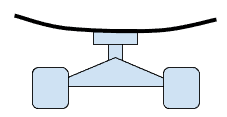
There are several types of concave, each aiming to reinforce foot placement and grip. Downhill and freeride boards typically have deeper concave than cruisers. Danse boards are quite flat.
While concave refers to curving along the width of the longboard, camber is the curve that runs along the board’s length, with the middle of the board higher than the ends. Rocker is the opposite, that is the curve has a lower point in the middle that at each end.


Комментарии
Отправить комментарий